

Alexej von Jawlensky
Torschok
1864 -
Wiesbaden
1941
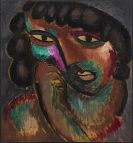
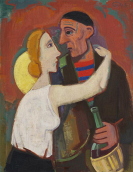
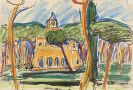
Jawlensky only began his artistic training in 1889 in St. Petersburg after a career as an officer in the tsarist army. He studied under Ilja Repin who introduced him to Marianne von Werefkin and Helene Nesnakomoff, his later wife. Jawlensky accompanied these two to Munich in 1896 where they wanted to visit a private art school. Here Jawlensky met Wassily Kandinsky. The artist undertook several trips to France and was able to show ten paintings at the 'Salon d'automne' with the help of Sergej Djagilev. Jawlensky also met Henri Matisse for the first time. In summer 1908 he worked with Kandinsky, Marianne von Werefkin and Gabriele Münter in Murnau for the first time. There, the four artists developed the idea for the foundation of the 'Neue Künstlervereinigung München' to which they aligned with other artists. In December the first exhibition took place in Munich. Two years later the 'Blauer Reiter' was established as a new idea of co-operation. In 1913 Jawlensky participated in Herwarth Walden's first German autumn Salon in Berlin. When in 1914 world war I began, Jawlensky was expelled from Germany due to his Russian citizenship. He moved with his family and Marianne von Werefkin to Prex on Lake Geneva. And remained in Switzerland until 1921, where he began painting his abstract heads in 1918. His final move to Wiesbaden took place in 1921. An attack of arthritis in 1929 forced the artist to visit various spas at regular intervals. Jawlensky suffered from a progressing paralysis and had difficulties in painting. One year later the painter began the series of small-format 'Meditationen'. 72 of his works were confiscated in 1937 as "degenerate". Three years later in 1941 Jawlensky died in Wiesbaden. At the beginning Jawlensky's style was influenced by the Fauves, particularly by Matisse, but the artist soon discovered his own, Expressionist style, which is characterised by strong colours and simple forms. Later he turned to those calm, spiritualised and mystical images of the Human face, which are so typical of Jawlensky.


Would you like to sell a work by Alexej von Jawlensky?
Infos for seller


Starting bid: 5,500 EUR